Good morning!
Under the surface, scientists have been tracking kelp forests—the backbone of ocean ecosystems—using satellite images; explore data HERE. Now, southern African kelp forests, which are faring better than many, are added to the roster. Celebrate kelp and read on about female athlete prowess and whale poop power. |
ChatGPT has its appeal for those who view “ChatGPT-4 as a friend.” But updates don’t always improve GPT’s friendship characteristics, such as a recent one that caused it to excessively flatter people in sometimes inappropriate ways. After GPT-4o applauded someone for not taking their schizophrenia medicine, Open AI pulled the update for being too “sycophantic.” |
Get Award-Winning Science Stories For Free |
You may know Nautilus is an award-winning science publication written—and read—by some of the brightest living thinkers, but did you know Nautilus also has a free newsletter? Sign up today and join over 540,000+ readers who get Nautilus’ unique brand of science storytelling delivered right to their inbox for free. |
Cicadas get turned into loudspeakers with abdominal electrodes |
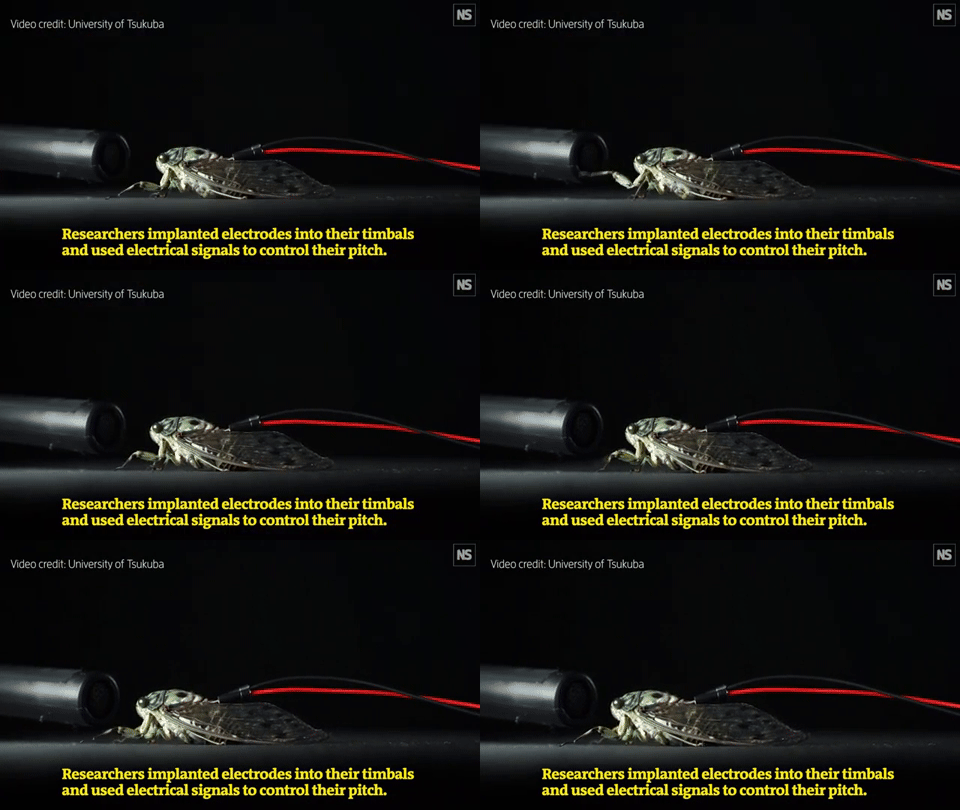
Cicadas are renowned for their loud songs, inspiring ancient poetry and verse. Males, in trying to attract females, make the shrill trills by vibrating their ridged structures called tymbals. Cicadas’ hollow abdomens amplify the sounds that are emitted at 300-400/second. Inspired by the mechanism, a new study coopts cicadas to make music.
Researchers implanted male cicadas with electrodes connecting to their tymbal muscles. Each cicada’s wings were pinned to keep it from moving away from the microphone set in front of it. None of this seems very kind, but the result was …interesting. Listen HERE to Pachelbel’s Canon run through a cicada.
Why such an odd experiment? The Tsukuba researchers were following in the footsteps of previous initiatives to turn insects into useful robots, such as a 2021 experiment to enable cockroaches for search and rescue. The vision for the altered cicadas is that they might roam around and transmit emergency messages.
Oops, squashed the messenger! |
Women are overtaking men in extreme sports |
In 2004, researchers predicted that by 2156, women would beat men in the 100-meter sprint. Only time will tell, but women have indeed been narrowing the gap in sports, and especially in extreme sports. A recent study assessed performance in an Alaska Mountain Wilderness Ski Classic expedition that takes place in the “austere circumstances” of the Arctic Winter.
Researchers measured energy expenditure, water turnover, and changes in body composition in 8 female and 12 male participants during the approximately 8-day ordeal. The women exhibited more total energy expenditure, but less expenditure relative to their loads, suggesting more female metabolic efficiency.
The difference may reflect an “Arctic shift” that women undergo, generating more body heat at lower outside temperatures, according to Frontiers in Physiology. In ultramarathons, a few women have outcompeted men, such as when Hiroko Okiyama became the first woman to win the Deutschlandlauf, finishing 8 hours before the second place (man)! Despite the male testosterone advantage, women are catching up. |
Giant invisible space cloud discovered by detecting molecular gas |
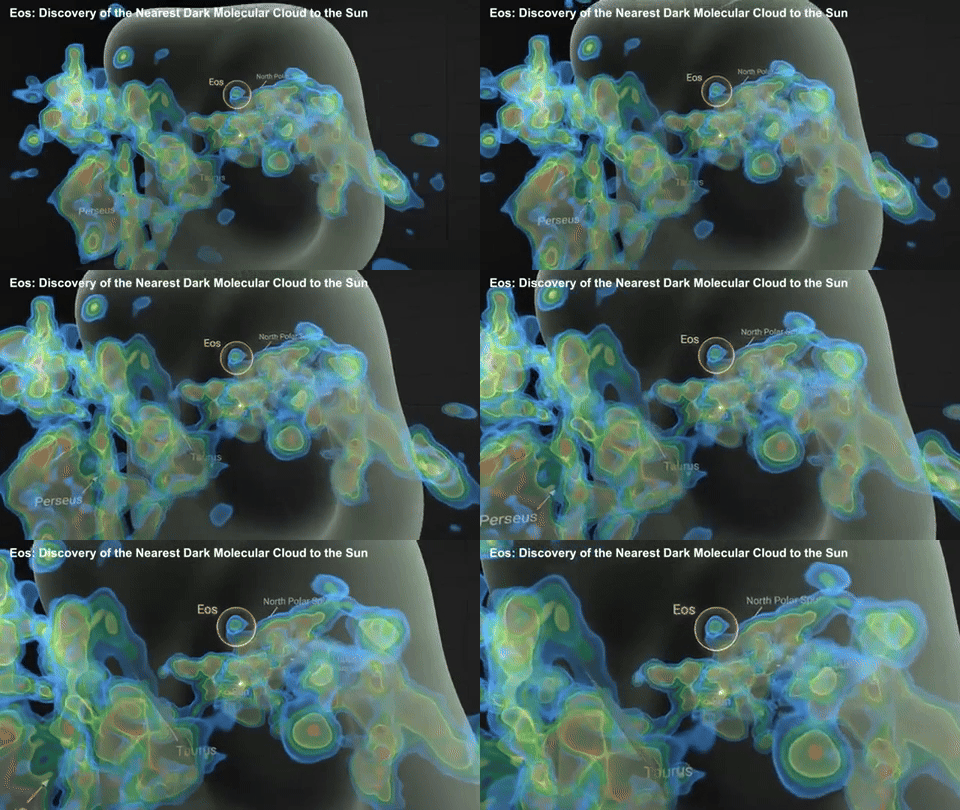
How could we have missed it all this time? A huge star-forming cloud, one of the largest objects in our atmosphere was detected by astrophysicists, as described in a new paper. Dubbed “Eos,” it’s quite close to the Sun and Earth (several hundred light years from each).
The cloud, made of gas and dust, had previously escaped detection by traditional observation techniques that couldn’t pick up its unusual chemical signal. By looking at images from a spectrograph carried by a Korean satellite, researchers found Eos’s hydrogen emitting in the far ultraviolet part of the light spectrum. Explained study author Blakesley Burkhart, “The data showed glowing hydrogen molecules detected via fluorescence in the far ultraviolet. This cloud is literally glowing in the dark."
Understanding molecular hydrogen clouds will help illuminate the origins of stars and planets from balls of gas and dust. And we’ve got a bit of time, since despite its mass of 3,400 times the Sun, Eos won’t evaporate for an estimated 6 million years. |

|

|
Because whales are massive animals, they excrete a lot of waste. And research is showing that whale waste is critical to ocean food chains.
For example, the ~15,000 minke whales that visit the Arctic’s Svalbard archipelago during summer produce more than 600 tons of poop per day, the weight of about 100 elephants. Because it’s loaded with nutrients like phosphorus and nitrogen, the whale poo fertilizes the ocean. “Based on a rough estimate, the minke whale poo contributes around 0.2 to 4 percent of the daily phytoplankton production in the area. That may not sound like much, but it is actually quite a significant contribution,” says marine scientist Carla Freitas.
When whales were much more abundant, before commercial whaling, their impact on ocean ecosystems was correspondingly greater. Significant amounts of trace minerals iron and copper—elements that are typically limited in ecosystems—in blue whale poop perhaps explain the decline of krill along with whales. Says oceanography student Patrick Monreal, “Our analysis suggests that the decimation of baleen whale populations from historical whaling could have had larger biogeochemical implications for the Southern Ocean, an area crucially important to global carbon cycling.”
Whale pee also plays an important role in ocean nutrient cycling. Researchers estimated the flux of urine from migrating gray, humpback, and right whales as they travel from feeding grounds to lower-latitude wintering grounds. Whales move an estimated 3784 tons of nitrogen per year, given that a single whale pees as much as 950 liters of urine per day. Ecologist Kirsten Young and climate scientist Marion Rossi write that “whale urine … stimulates phytoplankton growth and photosynthesis. This increase in the rate of photosynthesis could lead to 18,180 tons of carbon being drawn down from the atmosphere.”
And when a whale dies, its body gives a colossal mass of nutrients back to the ecosystem, including carbon, sulfur, and methane. In what the Florida Museum refers to as “a whale’s final contribution to its underwater home,” the carcass becomes a focal point for a feeding frenzy by animals that range from tiny polychaetes to crabs and sharks.
“We don’t think of animals other than humans having an impact on a planetary scale,” says oceanographer Andrew Pershing, “but the whales really do.” |

|
In the next issue, we’ll ponder the relevance of Henry D. Thoreau these days. |
Written by Devin Reese, Edited by Jake Currie
Copyright © 2023 Nerd Snacks, All rights reserved.
You are receiving this email because you signed up for the Nerd Snacks Newsletter
Don't want to hear from us anymore?
We understand, but it won’t be the same without you!
Click here to unsubscribe
|
|
|
|
|