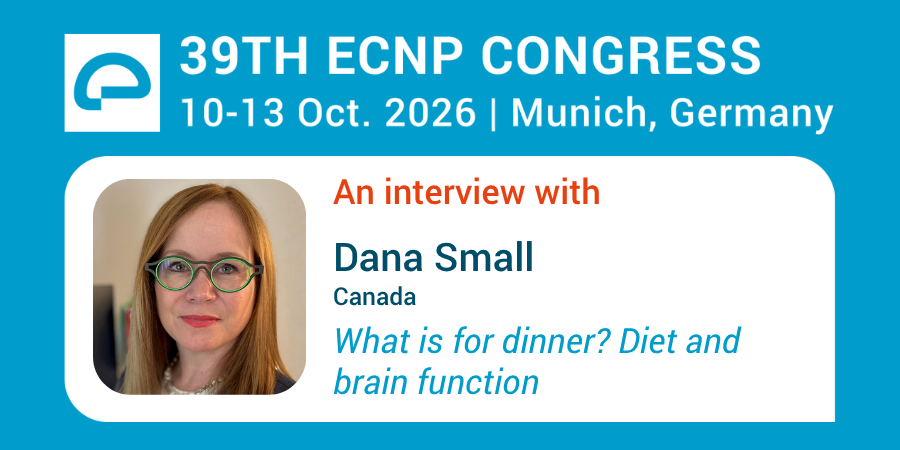
Tom Parkhill: Professor Small, your talk at the ECNP Congress will be on diet and brain function. Now, obviously, there's been a significant focus on this in recent years, for example the role of the microbiome in mental health. The idea that you are what you eat seems to be an idea whose time has come. So can you tell me a little bit about your background and how you ended up doing what you're doing and how you found your way into this field?
Dana Small: My training is actually in neuroscience and clinical neuropsychology. When I was a graduate student, neuroimaging had just become available. I had been working with animal models, but I was really interested in motivated behaviour, and in particular, how consciousness and how experiences of pleasure contributed to adaptive behaviour. This is easier to study in humans. I had been used to working in drug models in animals, but it's not trivial to give healthy humans drugs. So I thought, okay, what do people really like, what is an alternative?
Chocolate was the obvious answer. So we started doing studies using neuroimaging with volunteers eating chocolate. Our thoughts were, can we get people to eat chocolate – people who really like chocolate – and then push them to eat beyond satiety and see how the brain tracks the changes in value to changes in internal state. This was the first neuroimaging study of feeding, and it put me on the track of looking at not only perception, like taste, smell, and flavour and pleasure, but also to try to understand how the body and the brain work together to drive behaviour.
Initially we used feeding because we could get the value of the exact same thing to change just by feeding people and changing the value by changing internal state. For many years the signals were thought to be inhibitory. This meant that if you start eating, you have nutrients in your blood which increase, glucose for example. And so you have satiety signals that reach the brain, and these are largely signals that stop you from eating. Certainly this is dysregulated in overweight and obesity. But about 15 years ago, we (and others) realised that the critical signals driving eating and driving food reward or food reinforcement were generated in the gut. This means that food is not rewarding because it tastes good, but that food tastes good because it's rewarding. We had it backwards.
Let’s take sugar as an example. Sugar is the quintessential reward for cells, when you eat sugar and you oxidise glucose. There's a sensor in the body, just outside the liver, that senses the oxidation and drives dopamine release. Dopamine release is critical for motivating behaviour – and totally subliminal, it has nothing to do with pleasure. That's the critical pathway that you need in order to sustain eating. And starting from there, I became very interested in body-brain interactions, how this fits with changes to the food environment. How that system of body-brain communication can disrupt not only behaviour, but also metabolism.
Imagine if I showed you a picture of a bunch of different beers, you see these glasses and they're slightly different colours. You could probably make a pretty good prediction about which of those glasses you would like to have, based just on the colour. You could probably even predict how tipsy each might make you feel, or how full you would feel after each one of these different glasses. And that's because these visual cues have been associated with all of these body signals about the nutritional value, but also how that affects your internal state.
A more healthy and ecological example might be ripe strawberries. Imagine you're foraging for food. You see a strawberry bush. You can look at all those strawberries, and very subtle differences in the redness will tell you which one's going to be sweeter. And so you'll pick that one. The sweetness is going to be related to how much energy is in that food, and we will have associated energy with sweetness and sweetness with redness. And so that's how the body and the brain work together to optimise choice. But at the same time, when you now look at a strawberry bush or at glasses of beer, just the mere sight is going to cause metabolic responses, like release of insulin or changing of liver metabolism. And those that are called cephalic phase responses are really critical for optimising metabolism.
The metabolic fate of something you consume will differ depending on the capacity you have to prepare for that food, for that energy coming in. And normally in the environment there are very stable relationships. So sweetness is associated with energy. In the modern food environment, that's sort of been turned on its head. We are used to having an environment where all these very stable relationships can be learned, but now there's so many of these different pairings that it creates problems for metabolism, but also for the choices we make. This interested me: how do the body and brain work together to optimise behaviour, but also how does our changing food environment impact that system. This is really what I ended up focusing on, coming from a neuroscience background.
That's interesting, because evolution is about how we adapt to the environment. And our food environment has changed enormously over the last 100 years, so we're sitting in a completely different stew here.
Exactly. There's a very famous book called Catching Fire by Richard Wrangham, who is an anthropologist at Harvard. The thesis of the book is that fire made us human, cooking made us human. This is because fire allowed us to cook food, which meant that we had more access to nutrients because we didn't have to chew so much, as the nutrients were already half-digested before we ate them.
Early hominins had these large rib cages and big intestines, metabolically very costly tissues. But when we were able to cook, then those became redundant. We could select big brains rather than big intestines. And so the thesis is really that it's the food environment that allowed big brains to develop, and in fact our brains consume up to 20% of our energy intake. Now we can look food processing as another one of these major changes, which could also drive evolution of new systems. Or it could just result in a whole lot of challenges to physiology and chronic diseases across the board, which is what seems to have happened.
What do you think this means for mental health?
For mental health? There's an enormous comorbidity between obesity and anxiety and depression, and it's probably quite bidirectional. But there's 100% very strong evidence that if you ingest (in particular) saturated fats, that you can very quickly induce anxiety. I do think that the food environment, metabolic dysfunction, inflammation and adiposity, all these things have enormous effects on brain health. There's a ton of evidence linking obesity and diet to depression and anxiety.
It is also the case that many psychiatric disorders are associated with changes in appetite and that the drugs that we use to treat mental health conditions often have metabolic consequences. Think about schizophrenia, all the effective atypical antipsychotics cause massive weight gain. So, the food environment promotes overeating of unhealthy food that is not great for the brain and you see associations between mental health, diet and obesity. Here the quality of the food and where you live is really important. Italy, where you live, is a different story.
Italy is a different story.
It is, it really is. And I mean, I think actually Italy, France, Japan are great examples of the idea that you can eat high-energy dense, wonderful foods and not, as a society, become massively obese. And part of it is because those recipes are family recipes with reliable flavour-nutrient associations. There is less industrial food processing and people tend to eat the same foods, in the same order, at the same time each day. In this context, it is easier to refine predictions from sensory experiences to optimise metabolism.
Well I live in Italy, but I was brought up in Scotland.
My family comes from Scotland too.
Scottish food is not my favourite! But you know, it's always struck me as remarkable that you can have such extreme cultural differences to food, and this obviously feeds into your brain health in different ways. The work that you're doing implies that our cultural settings change the environmental soup in which we sit, which of course will have differing effects on our brains.
Absolutely. At the ECNP Congress I will talk less about why we overeat and the food environment’s interaction with physiology, and more about the consequences. For example, the work that we've done linking obesity with cognitive decline. There's a ton of correlative data showing that higher BMI is associated with lower cognitive function. We've done a lot of work looking at this relationship and uncovering bidirectional relationships. Cognition influences eating behaviour and eating behaviour influences cognition. The other thing I want to talk about is how the dopamine system is affected by diet and obesity.
In what way?
Dopamine's involved in a ton of behaviour, including executive function, self-control, adaptive learning, and so on. And so you can have, for example, somebody exposed to a diet causing adaptations in the dopamine system, which impair learning, and then problems with that learning predict whether or not you're going to be successful on a weight loss trial. So the environment is creating risk that makes it even harder to lose weight through changing brain circuits.
How do you think this work might impact the jobbing psychiatrist, the clinician who just is dealing with people coming through the door, being presented with such a changing background environment?
I think we need to change the food environment. I mean, I think all of the GLP-1 obesity drugs are wonderful, and are a really important part of treatment. But still, it's the food that causes a lot of the problem. The moment you stop taking these medications, you gain the weight back because the food environment hasn't changed. And ultimately, it's the type of food that you're eating that is related to health. If you look at Japan, France, Italy, the countries that celebrate cuisine actually have some of the lowest rates of obesity.
I remember 25 years ago talking to Steve Bloom in London, who was complaining how the obesogenic environment has changed everything. But the solution was not necessarily to change our chemistry, it was to change the environment.
Yep. It still is, it really still is. And I think there is a place for science in making these changes. First of all, you need the evidence to be really strong so that, you know, legislators and people interested in policy have arguments to make. But then we also have to figure out how to use processing to our advantage, because that's the only way to feed the planet. And so that will require scientists to be involved. But it is a different model of action than trying to understand what's wrong with physiology and then fix it. We don't as a field know how to do that yet, it requires very multidisciplinary work, between scientists and agriculture.
One last thing. Has your research changed what you eat personally?
Oh, yes. I avoid artificial sweeteners, and I really eat to maximise pleasure. At one point after I was pregnant I gained a lot of weight. It was stressful, I was up for tenure, my husband was working 100 hours a week, I had a new baby and I couldn't exercise. I gained a lot of weight, and I developed pre-diabetes and my doctor said, “you need to lose 20 pounds [9 kg]”. So I took a week off and I thought about what I like to eat. I spent the whole week going grocery shopping and cooking, so that I could find delicious meals that I could make easily enough. I knew where to get everything to make those meals, and those were the meals that I really like to eat. Because if I don't really like it, it's not going to work. And so the biggest effect that my science has had on my eating is by not demonising pleasure, but actually focusing on it and maximising it. That's not necessarily the strategy most people take to maintain weight loss!
Sounds good to me! Thanks for talking to me, I’m looking forward to hearing your talk in Munich.
To join the 39th ECNP Congress, click the button below: