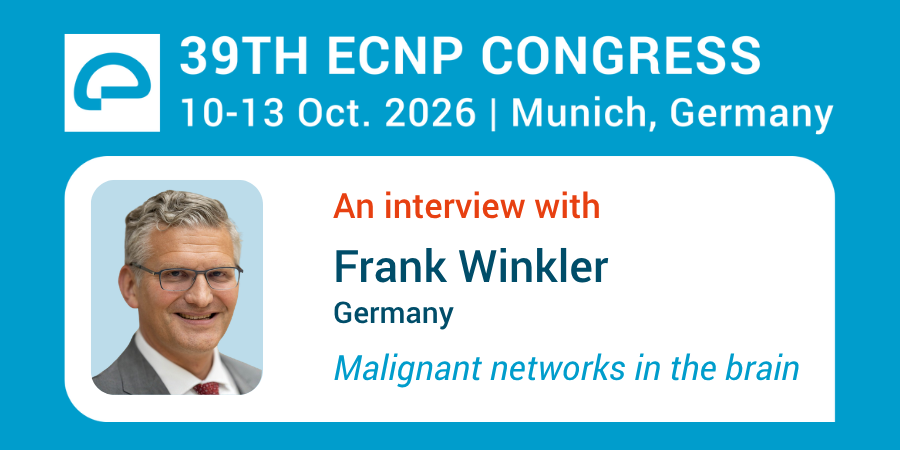
Tom Parkhill: Professor Winkler, thanks for taking the time to talk today. Let’s begin at the beginning: you have said that you don't come from an academic background. So, what first brought you into science?
Frank Winkler: That’s a good question, and I wish I had a definite answer. Maybe it arises from some kind of serendipity, but it probably comes from having a very deep-rooted interest in understanding how the world organises itself, how everything is connected, how things function and work.
My father is a Hamburg merchant and I’m the first academic in my family. My parents were extremely caring. They made it possible for me to go to a very good high school in Germany. I had no guidance or mentorship, so I followed my heart. Ever since I was a two-year-old boy, I felt I wanted to become a doctor; I can't even begin to remember or explain why. I was probably impressed by my paediatrician – I remember a very tall guy, dark voice, he seemed to know everything – so maybe I just wanted to become like him. So, I decided to study medicine. At university I made lots of contacts with a lot of people from different parts of academia, and I really felt comfortable in that environment. I completed my doctoral thesis but I was still undecided about exactly which field I wanted to follow. Talking to young students today, I'm always impressed by what a clear vision of their future they have. I'm not sure I ever had that.
You ended up being one of the founders of cancer neuroscience, which was a subject that people wouldn’t have even thought of just a few years ago. How did this come about?
Maybe this sort of thing can happen if you don’t have a clear career path. This is probably also true of my fellow Brain Prize winner Michellele Monje. Without this clear path you are more free to take a different route, you have the flexibility to think about different directions.
In fact I only I fell in love with neurology when I was doing my last year internship at the National Hospital for Neurology at Queen's Square in London. I started working on bacterial meningitis, but I quickly realised that brain tumours were undertreated. We didn’t have a lot of good therapies, and I suspected that we could do more, that there was much more we could learn about these tumours.
I went to Harvard for a two-year postdoc and learned intravital photomicroscopy, which is an important methodology in neuroscience. I was really intrigued by the ability to follow a single cancer cell and to study its dynamic interaction with the brain over a period of days, weeks, months, perhaps stretching even more than a year. And so that’s actually when we started to see strange things: tumour cells invading the brain, colonising the brain; typical problems of these incurable gliomas, these primary brain tumours. And by doing that, they were extending and extracting processes that looked a lot like neurites in the developing nervous system. We were studying biology ‘in four dimensions,’ but we were shocked to see this happen. We saw how these tumour cells interconnect to form a neural-like network – not neuronal, but neural-like, communicating via intercellular calcium waves. This network was even capable of performing almost intelligent tasks. And that was really mind-blowing for me. Even in the first days of this discovery, we decided to call it the “Brain in the Brain Project”.
Later we discovered – together with Varun Venkataramani and Thomas Kuner here in Heidelberg – that there are indeed synapses; so bona fide, functional, excitatory, glutamatergic synapses with AMPA receptors, particularly calcium AMPA receptors on the tumour cell side. And these long neurite-like processes, very stable, were actually like dendrites for the tumour cells. And they received constant synaptic input by remote neuronal activity and also by hyperexcitability, which is of course typical for these tumours – most patients suffer from epileptic seizure. So, in the end, this was really a breakthrough finding. And it was so exciting when I was talking to Michelle Monje in 2015 – here in this very room where I’m sitting now, in Heidelberg – and Michelle told me, “Okay, we’ve discovered something crazy”. And then I said, “No, Michelle, we’ve discovered something crazy”. And then it took us five minutes back and forth to find out that we had discovered the same thing, these crazy neuronal cancer synapses.
We had liked each other before that point, but from then on, we really became friends. It was amazing to see where the journey led us, and to think where it might go in the future. We worked together on papers, through primary submission, revision, secondary submission. And we developed a kind of strong bond through this academic partnership. I learned a lot. I learned that it's always better to collaborate than to try to scoop your peers. I think this is still true of cancer neuroscience today. We have a lot of very strong partnerships, collaborations, with a lot of international co-ordination.
I’m co-ordinating a large German collaborative research centre initiative at this moment in cancer neuroscience, where we are increasingly leaving the brain itself to understand what's going on with the large extracranial cancer types. The last few years have taught us about the importance of neuronal input and neural-like features in dictating brain tumour initiation and progression: progression, invasion, therapy resistance, you name it, et cetera – all key hallmarks of cancer. But we now find that the peripheral nervous system, which is of course everywhere in our body governing many bodily functions – such as wound healing, repair, stem cell functions – is also very much involved in the initiation, growth, progression, metastasis, and resistance of more or less all cancers that have been studied so far. This includes lung cancer, breast cancer, prostate cancer, pancreatic cancer, all these large cancer types. And these are partially driven by direct brain, PNS, cancer, circuits, sometimes even involving the immune system as a communicating agent. The nervous system dramatically influences immune function, and this in turn dramatically influences anti-cancer immunity, and so on.
All these exciting findings of the last years are coming together, and I think we have now a significant new understanding how cancer works. This really makes neuroscience so much more important. And all neuroscientists, both young and older, now really need to push this future forward, particularly for cancers outside the brain, where the research has so far been conducted by general cancer researchers, rather than by neuroscientists. This is one of the concepts that we want to follow. And I figure that's the direction for the future of the field now.
There are a couple of things that come to mind. One is the difficulty of actually looking at effectively developmental processes in living human cancer patients.
So you mean mental processes? Of course, we do know that brain tumours do influence massively the function of the normal brain, not just by their space occupation, but also by reprogramming the brain in very distinct ways that help them to grow. And the same seems to be true also for extracranial cancers. They seem to be able to reprogramme certain neuronal populations in the brain in a very specific way, which again helps their progression. So, it’s really a vicious cycle of brain-body cancer communication. That's certainly another extremely interesting part of the field.
But can you cognitively influence cancer? That’s of course, a super interesting question, and not an easy one to discuss with patients. I must say, I treat a lot of brain tumour patients every day. And I’ve seen – and many of my peers have seen – that there are many brain tumour patients who have been treated but where we might expect a recurrence every couple of years with very, very few exceptions (I’m talking about, for example, MGMT promoter unmethylated glioblastoma, where you can normally be sure after two years there would be a recurrence). And these few exceptions seem to have a very specific mindset, or personality. They are extremely relaxed, with an extremely non-anxious personality; very prone to mind relaxation, yoga, meditation, progressive muscle relaxation, etc. Of course, all of this can be coincidence, but we need to kind of look at this more systematically.
I’m now asking all of these patients to write down what they believe they are doing differently, or why they think they are still alive. And what I get back from them is almost copy and paste. It’s always the same description of an extremely relaxed, self-aware, extremely non-anxious personality, which is interesting. It’s something that struck me even when I talked with them and told them the diagnosis and they told me, “Well, doctor, you tell me the diagnosis. I know what you're saying, but this cannot affect me because I am stronger than this glaurostoma.” This is an unusual reaction, right? I don't think I would myself react to this news like that.
I'm not saying that we will be ever able to instruct or tell patients to perform certain cognitive actions or relaxation techniques or whatever. But we now have some completely new ideas on what to try. I would say also from my own experience that quality of life is better anyway when you have these attitudes, particularly in cancer. This has not been looked at in brain tumours for some reason, but in extracranial cancers it has been found that when you apply stress and pain and depressive-like situations to mice that have been implanted with tumours, these tumours grow two, three, four times faster. They metastasise much more, mice die much earlier, and so on. So it seems that adrenaline or noradrenaline and cortisone, et cetera, are strong drivers of cancer progression, and this is pretty well known. So, it’s not, let’s say, so “metaphysical” to think about these aspects. It’s pretty much hardwired to what we’re talking about here.
I want to change the subject just a little bit. I see that you and your wife, Eva (who is a well-known medical ethicist), are involved in a foundation called (in English) Stand Up for Democracy. What moved you to do this?
Like many of us now, at least in the Western Hemisphere, we are increasingly frightened about losing what is really dear and valuable to us, including the ability to undertake science in a free environment, which means an environment where you are able to speak up. And when you have a well-founded theory or scientific results, you can be sure that you’re able to communicate these results and at least are not fighting against powers that are trying to suppress facts, suppress truth, suppress science, because they see science as an enemy. So professors are the enemy or science is the enemy. This is very concerning because I strongly believe that democracy and science are heavily intertwined and depend on each other. It’s not a coincidence that democracy and science were simultaneously developed in ancient Greece. So, I think it’s now time for us scientists to try make ourselves more understandable than we used to be, to leave our ivory towers and go to places which are outside of our comfort zone – which also means that you join political parties, try to change things, try to influence science policy. This is actually something that I’ve found an extremely positive experience. It’s surprising how much you can really achieve and change without getting too much involved. I mean, I have a quite busy day and busy week, but I don’t need a lot of time for these additional activities. It’s much better for you than doom scrolling through the news.
This is this classical concept of how you get a rat or mouse depressed, learned helplessness. They are subjected to electric shocks. If they can’t control the frequency of the shocks, they get depressed. If they can control the frequency, then they don’t get depressed. I think this is quite a well-established element of how depression can work. So to fight my political depression, we set up the organisation. My wife Eva is vice-chair of the German Ethics Council, so she’s a quite renowned medical ethicist, as you said. It’s important, I think, that science itself stays non-political, and we ourselves don’t want to be seen as activists, which might expose us to criticisms. However, we should be open to communicate science better, to communicate better to politicians. And we need to avoid talking down to people, we really need to listen to the public, listen to people, listen to patients.
Thanks very much, I’m looking forward to hearing your talk.
Professor Frank Winkler will present the Brain Prize Lecture entitled "Malignant networks in the brain" on Monday 12 October 2026.
To join the 39th ECNP Congress, click the button below: