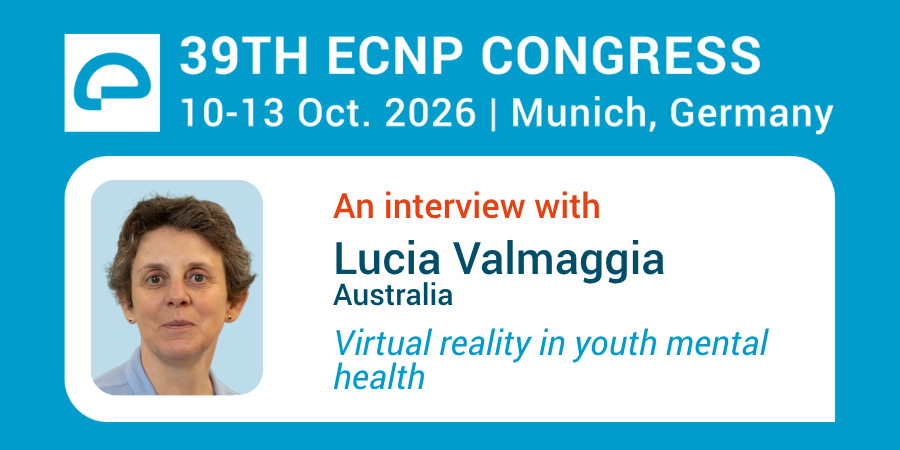
Tom Parkhill: Professor Valmaggia, could you give me a little bit of background, because obviously you’re based in Melbourne now, and you worked in London, but you have an Italian name, so…
Lucia Valmaggia: Yes, I am Italian. I’m from Milan. I grew up in Milan, but I moved from Italy to the Netherlands after high school. I studied for a MSc in clinical psychology at the University of Groningen. And then I did my PhD as an external student at the University of Manchester, after which I went to do a postdoc at King’s College London. I stayed for 20 years. I became a professor there and then, two and a half years ago now, I moved to Melbourne.
I see in London, you started working with young people, young people with psychosis. What attracted you to that?
I was already working with young people with psychosis when I was in the Netherlands. I did my PhD on this, it was one of the first studies looking at whether cognitive behavioural therapy could be of use for people who heard voices or had beliefs that other people didn’t share, also called delusions. We had an early intervention service where I was working. I moved to London to work in an early intervention service – actually an early detection service – called Oasis, Outreach And Support In South London. I helped set up the service, so I was working clinically for a few days every week, and then in research one or two days a week. I found I was moving more and more into research and academia as time went by, but I always kept the clinical work going.
You were also involved in looking at young people moving into the criminal justice system.
At the time we started OASIS in Prison, we were the only group doing this – in fact, I don’t know if in the meantime other groups were established to research early detection in a custodial setting. We started the first early detection service in a prison setting because we found that some of the people who came from less affluent backgrounds sometimes enter the criminal justice system before they entered the mental health system. So we wanted to see whether they presented with similar symptoms and to understand which type of help they were getting, if any. We were awarded research grants to investigate this. We found that indeed young people from disadvantaged areas came into the criminal justice system and then ended up in a prison setting. And they were keen to get support for their mental health. They were help-accepting, even if they weren’t seeking help per se. However, we needed to adapt our interventions in order to meet the needs of the young people in a custodial environment. This would be in the 2010 to 2017 period. Sadly, around that time the government cut a lot of the funding for health systems in prison, and this included cuts in the provision of mental health services in the criminal justice system generally.
And at that time, I had been working with virtual reality applied to mental health for several years and I made the decision to set aside more time for it and to focus on expanding the virtual reality lab at King’s. I was able to appoint Jerome Di Pietro as the VR developer and that allowed us to establish a library of VR assets and environments to grow the lab from one or two studies to around 12 studies. The VR Lab at KCL is now led by Prof. Matteo Cella and has several projects up and running. At the end of 2023 I moved to Melbourne to continue the work. The Centre for Youth Mental Health wanted someone who could lead and expand the Orygen Digital virtual reality programme. In the last two and half years the XR Innovation Lab has grown to 23 members of staff, including clinicians, researchers, VR developers, peer researchers and PhD students. At the moment we’ve got four studies running, with a few more in the pipeline, depending on funding, of course.
The Centre for Youth Mental Health is part of the University of Melbourne, and we are co-located with Orygen. Orygen is the largest centre for Youth Mental Health in the world at the moment, in terms of number of people employed in and the number of clinical and research programmes in youth. We serve people who are aged 12 to 25.
Orygen employs over 600 people, including 200 researchers. It is composed of 12 professorial teams. So there is research going on in several areas, including eating disorders, depression, anxiety, mood disorders, addictive behaviours, and psychosis. In our XR (extended reality) lab at the moment, we have studies around conduct disorder, psychosis and ultra-high risk for psychosis. We’re also running a study on depression and anxiety. We have a study researching the use of VR to help young people entering the job market and we also have a separate study with the Australian Football League to help young players improve their resilience to stress in sports.
I work three days a week as an academic and two days a week in a community team which provides primary and secondary consultations for young people with criminal justice system involvement. At the moment I’m trying to get money to combine my work in VR with my clinical work and further develop VR interventions for emotion regulation.
I've been looking in the Orygen website and it says, “Our vision is to make VR part of routine care for all young people being treated for mental ill health”. That’s quite ambitious.
It is very ambitious, and perhaps a strong statement. But you may have also seen that Orygen has the words “revolution in mind” very prominently on our website and other resources. We’re really trying to change things at the service level.
The XR lab is part of Orygen Digital, which employs around 130 people in total: clinical psychologists, psychiatrists, nurses and other allied mental health professionals. But importantly also we’ve got engineers, computer scientists, VR developers, comic experts – you know, people who draw all the comics and content creators and stuff like that. And you may have seen that we also have a product called MOST, which is a digital platform to help young people everywhere in Australia. Younger people up to the age of 25 can use it, and over 10,000 users use it on a yearly basis. So Orygen is much more than our XR lab.
What’s the difference between XR and VR?
VR is when you’re fully inside a digital world using a headset, like for example, practising a speech in a virtual classroom. XR is the broader term that includes VR but also blends digital elements with the real world, like seeing virtual prompts or objects layered onto what you’re actually looking at.
What are the difficulties that you run into? As you said, funding in Britain was effectively withdrawn. And it seems that in Australia it’s a fairly open environment for this type of work. But what are the practical difficulties you have in introducing XR? And what does it bring to the show? What does virtual reality hold out the promise of?
Virtual reality is not new. It’s been around since the late 1950s, and it’s been used in mental health since the 1990s. However, what has changed is that around 2015 the gamers got very involved and they produced virtual reality headsets that were much cheaper than the older version that we used to have in labs. The difference in price went from 60,000 pounds to less than 500 pounds, so there was a huge, huge drop in price in a very short time. VR-assisted therapy has been used for a long time, especially in anxiety and phobias. In psychosis research, we’ve been using it from the late 90s, or the beginning of 2000s.
What does it bring to the show?
Well, for example, if you ask a young person what happened the last time they became paranoid or anxious, it might be quite difficult for them to remember what happened and to put themselves back in that situation. What virtual reality enables you to do is to put people in that situation, virtually, but their body responds in similar ways to the real situation; we have a lot of research showing that with three-dimensional VR, your body responds as if it were the real situation. But because it’s not the real situation, it’s easier for you to try new things, to control the variables.
It can help in two ways. One is in assessment. You can put someone, for example, in a virtual reality bus and you can ask them what’s happening. And they say, oh, those people are looking at me, they are looking at me strangely, they are laughing at me, or whatever it is that they are worried about. Or, for example, in phobias; maybe they are scared of dogs, you use virtual reality assisted therapy, as a way of delivering exposure to dogs.
So it allows you to control every single thing they see, because you are in charge of what is in that virtual world. You can start very gently. To take the bus example, you can start with an empty bus. Then put some people in the bus, people who are nice to you or less nice to you. Then you can add more extreme settings, where someone (or everyone) in the bus seems very angry with you. It’s very difficult to control this in in vivo exposure, unless you have to your disposal a number of actors and a director and so on. This is what virtual reality enables you to do, to practice in virtual reality strategies that you can then use in real life. Of course, that is just a bridge. You still have to do it in real life, otherwise it doesn't work!
So what are the barriers to actually introducing virtual reality? What are things that you're finding are making it more difficult?
In terms of the barriers to the introduction of virtual reality more widely, there are a number of them. The first and more important is that with one or two exceptions, there are still few evidence-based programmes that you can buy off the shelf and give to somebody to use. The number of products available is increasing, but only a few have been researched properly and have been shown be effective. So that that’s one issue, the field is still developing.
The second is that very few people receive any training around digital intervention or virtual reality intervention while they are studying to become a nurse or a psychologist or a doctor or any other health care professional. So there is this mismatch which we know from other innovations in healthcare. It takes a while before people are told how to use new techniques. Then, of course, there is also the fact that virtual reality headsets are not available in all clinics. They are becoming cheaper, but it’s still an issue.
For example, one of the studies we have here in Australia is called Mind (led by Dr Imogen Bell and Dr Jen Nicholas). We have given clinicians headsets and training on how to use this package, which is for depression and anxiety. People really embrace it and want to use it. But of course, the research trial comes to an end, and the health systems have to pick up the treatment. It takes a little while to introduce an innovative therapy. People want to use these therapies, and the evidence base is growing, so now is the time to implement it in the clinic.
You’ll be talking to the ECNP. How would you sum up your presentation?
Well, in my talk, I’ll explain what VR applied to mental health actually is and how it’s being used in therapy. I’ll go through the evidence base across different diagnoses and hopefully show that it’s a really promising way to deliver treatment in an innovative, engaging way that people are willing to use, and that’s also practical and easy for clinicians to deliver.
So young people are more likely to buy into it?
Yes. And it’s also good is to remember we’re not doing “anything new”. We are delivering interventions that we know work in an innovative and engaging way. It is also worth mentioning that it’s cost effective. You need fewer sessions to achieve the same level of progress for young people. Obviously, it’s not for everybody, but no treatment is. And the other thing that I think is very important for the ECNP is that many attending the Congress will be deciding on curricula in universities. We need to make sure that VR and other digital mental health innovations are taught at all levels during training.