Good morning!
In time for the new year, NASA’s Web Telescope captured images of Uranus that look like a camera lens staring back at it, here. But the bright, white core with 13 concentric rings is an icy polar cap surrounded by layers of a water-methane-ammonia fluid. And read on about cyborg rights, Rembrandt’s paints, and spider superpowers. |
Transpecies rights are not on most people’s radar. Nor have many met a cyborg—like Neil Harbisson with an implanted antenna for color perception he lacked from birth. His Transpecies Society cofounder Moon Ribas has foot implants that detect earthquakes. Explains Neil, “since they were born, [some people] haven’t felt 100% human for various reasons.” |
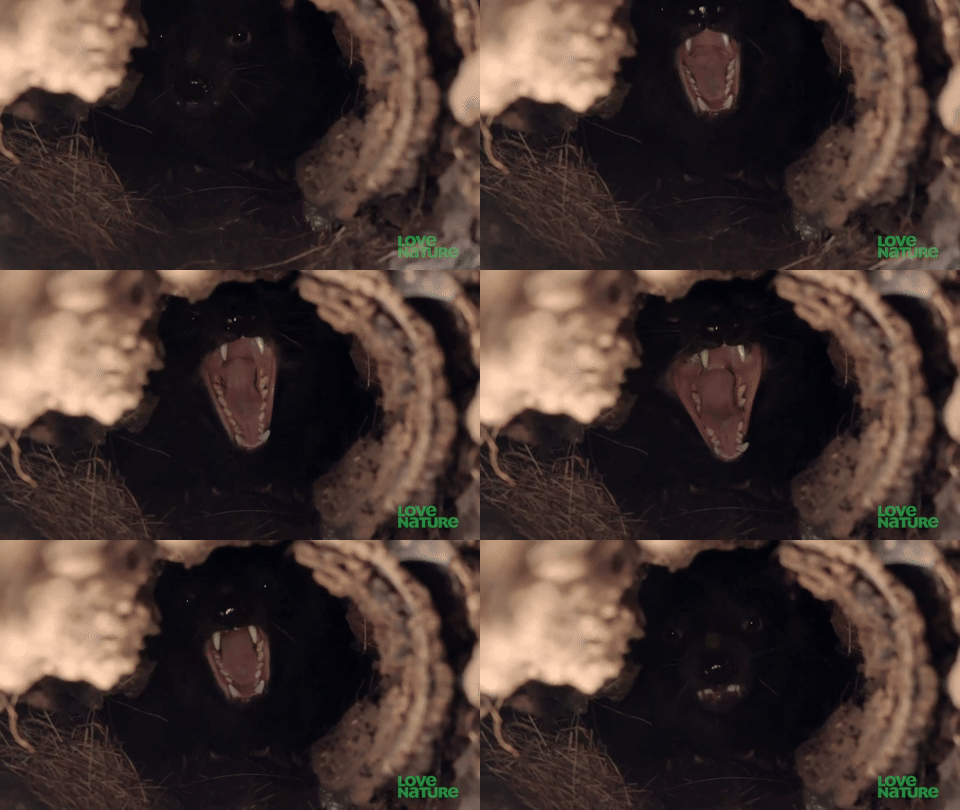
Tasmanian Devil teeth keep erupting as they grow |
The first tooth shed by a toddler gets celebrated around the world with traditions ranging from swapping it for tooth fairy funds, hurling it over the house, or offering it to a rat. But endangered Tasmanian Devils don’t share in the celebrations because they never lose their baby teeth.
Yet, young Tasmanian Devils have a dainty set of teeth suitable for their mouth size, and adults have larger teeth. A recent study shows how the teeth of Tasmanian Devils scale up as they grow up. “Instead of losing time changing over to a set of adult teeth like humans do, the devil’s teeth simply “erupt” gradually out of their jaws and gums,” explains study author Menna Jones.
When a Tasmanian Devil weans from its mom, it has to start killing and scavenging its own prey of little mammals, birds, or insects. But its body is just a third of the adult size. The adaptation of continuously erupting teeth allows it to act like a mini adult—fierce bite and all—so that it hits the ground running! |
The Night Watch painting reveals Rembrandt’s use of lead |
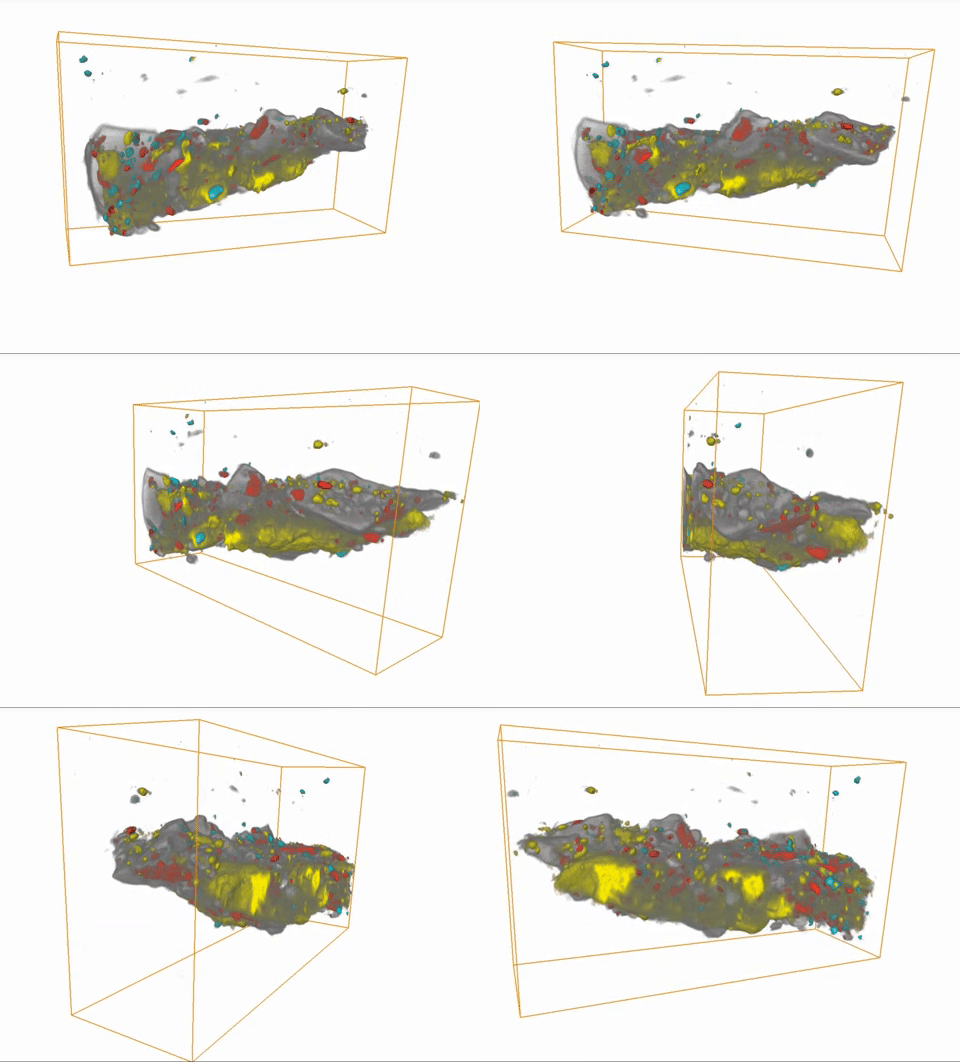
The Renaissance Masters couldn’t go down the street to Dupont to pick up their paints they were colorizing oils through experimentation with different pigmented materials. By Rembrandt’s time—the Dutch Golden Age—soil was used to make browns; charred bones to make black; and lapis lazuli to make blues. Now, a new study reports that Rembrandt was sneaking something else into the mix—lead.
Using imaging techniques that can read chemical identity, researchers detected a lead layer in the famous painting “The Night Watch.” Rembrandt apparently applied a lead compound (lead formate) to the canvas underneath the typical prep layer of gluey quartz-clay. It’s possible that he was shoring it up to last in dampness of Amsterdam’s Kloveniersdoelen where it would hang.
Regardless, the unusual ingredient shows that Rembrandt was innovating. Explains study author Katrien Keune, “The lead formate gives us valuable new clues about the possible use of lead-based oil paint by Rembrandt, the complex chemistry of historic oil paintings, and the potential impact of oil-based varnishes from past conservation treatments.” |
NASA sends mission to examine “God of Chaos” asteroid |
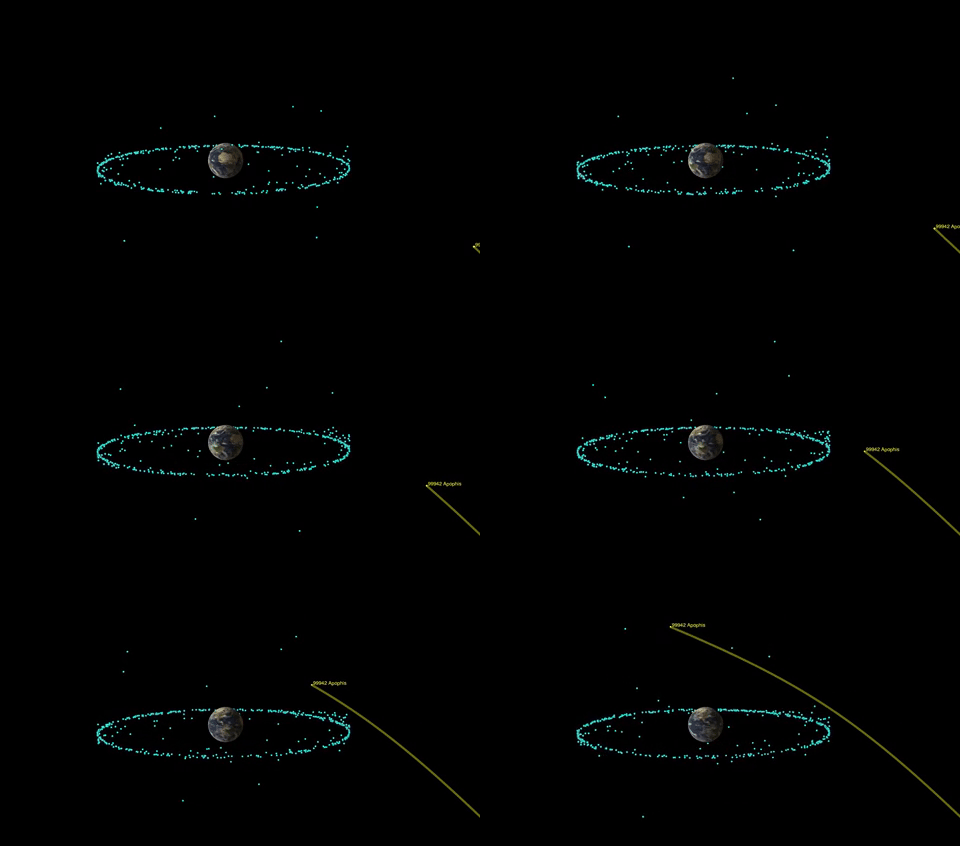
With the world’s woes of 2023, we look forward to a calmer 2024. So viewer discretion advised for this story about the 1,100-foot-wide asteroid (about the height of the Eiffel Tower) hurtling toward Earth. Asteroid Aphophis (“God of Chaos” in ancient Greece), is predicted to approach Earth on April 13, 2029.
Current projections have it safely pass by 20,000 miles away, although it will keep returning as it orbits the Sun, with a possible Earth collision a century down the road. For now, NASA views the 2024 proximity as an opportunity to learn more about this God of Chaos through the mission Osiris-Apex mission.
Recomissioned after visiting asteroid Bennu, the Osiris-Apex is flying closer to the Sun than ever, testing its heat resilience. Says Dani Mendoza DellaGiustina, “We’ve done a lot of modeling to ensure the spacecraft will be safe. But any time you take a piece of space flight hardware beyond the design criteria you incur risk.”
If it survives, Apex will reach Apophis in April 2029, just in time to take a closer look when it whizzes by Earth. |

|

|
Spider-Man’s spidey-sense perceives danger in his surroundings. It starts as a tingling behind the skull and allows him to achieve feats like swinging through the city without crashing into things. While impressive, the spiders he’s modeled after have a few sensory tricks of their own.
If you fell from a kayak miles out at sea, could you return to shore? A recent study reports that long-jawed orb weaver spiders (Tetragnatha elongata) orient to land using polarized light reflecting off the water. The study dropped spiders—some with their eyes painted over (method not sanctioned by Spider-Man)— into tanks and ponds. Land was simulated with polarizing film over the water’s edge.
The spiders that could see oriented unerringly to “land” with just the polarized light cue. “It’s hard to overstate how crazy these results are,” said study author Brian Gall. “I have dropped probably one thousand spiders onto the water’s surface, and I’ve almost never seen them make the wrong choice.”
Even eyeless cave spiders boast navigation abilities that rival spidy-senses. Many cave-dwelling animals have evolved reduced or absent eyes. A new study shows that spiders in the genus Leptonetela living in Chinese caves are nevertheless able to sense light and dark, retaining genes related to photosensitivity. When put into jugs with dark and light sides, they consistently chose the dark side.
Besides seeing without eyes, spiders can hear without ears. Their silk webs serve as an acoustic antenna for hearing sounds ranging from trapped prey to approaching dangers. A 2022 study showed how bridge spiders (Larinioides sclopetarius) detect sound from web vibrations through sensory organs on their claw tips. Said study author Ron Miles, “The spider is really a natural demonstration that this is a viable way to sense sound using viscous forces in the air on thin fibers.”
OK, so Spider-Man can do cool things with webs too, like shooting balls of silk to trap the bad guys. But can Spider-Man hang out underwater? Even his purported 8 minutes of breathholding pales next to the 30 minutes reported in a 2022 study for some semi-aquatic spiders. Researchers observed the spiders Trechalea extensa hiding underwater for more than a half hour when threatened (by the researchers!).
To achieve the feat, they deploy body hairs in a water-repelling net. Said study author Lindsey Swierk, “The film of air surrounding the spider when it is underwater appears to be held in place by hydrophobic hairs covering the spider’s entire body surface. It’s so complete that the spider almost looks like it’s been dipped in silver.” Beat that, Spider-Man! If all else fails, some spiders have super camouflage, far more sophisticated than Spider-Man’s polyester suit.
A study earlier this year of the jumping spider Siler Collingwoodi found that it crawls deceptively like an ant (see HERE), perhaps to fool predators who would prefer to eat a juicy spider than an ant. While its mimicry reduces its chance of death, only some predators were fooled. Praying mantises snapped up the “ants,” aka jumping spiders. |

|
For the next issue, we’ll take a deep look at sleep. |
Written by Devin Reese, Edited by Jake Currie
Copyright © 2023 Nerd Snacks, All rights reserved.
You are receiving this email because you signed up for the Nerd Snacks Newsletter
Don't want to hear from us anymore?
We understand, but it won’t be the same without you!
Click here to unsubscribe
|
|
|
|
|